Transport Fever 3 is the next entry in Urban Games’ transport-tycoon series, and it’s arriving with a bigger scope than either of its predecessors. If you’ve spent time in Transport Fever 2 building rail networks or shipping routes, this sequel is aimed squarely at you — it keeps the core “build a transport empire” idea but rebuilds the map generation, terrain, traffic, and cargo systems from the ground up. For players who like slow-burn economic strategy games where every route and vehicle choice has consequences, this is one of the more anticipated releases in the genre for late 2026.
Game Information
| Detail | Information |
|---|---|
| Game Title | Transport Fever 3 |
| Platform | Windows, macOS, Linux (confirmed on Steam & GOG); PlayStation 5, Xbox Series X/S (confirmed via developer/press announcements) |
| Release Date | September 29, 2026 |
| Genre | Business Simulation / Strategy (Tycoon, City Builder) |
| Developer | Urban Games |
| Publisher | Paradox Interactive |
| File Size | 90 GB (PC — minimum and recommended specs both list this) |
| Version/Update | Not yet released — no post-launch version history exists |
| Languages | English interface plus 12 more; full voice audio confirmed only for English and German, other languages get subtitles/text only |
About the Game
Transport Fever 3 puts you in charge of a transport company that grows across more than a century of history — starting with horse-drawn wagons and early steam trains and eventually reaching jet aircraft, supertankers, and high-speed rail. The core loop is straightforward on paper but gets complex fast: every delivery you complete earns money, but every vehicle you run adds to your costs, so the game is really about balancing route planning against operating expenses.
As your company grows, city demands scale up with it. Small towns need basic connections; large capital cities need dense, efficient networks that can move both people and cargo without bottlenecking. Success unlocks the ability to build real-world-inspired landmarks as a kind of achievement marker, while falling behind means you’re stuck troubleshooting inefficiencies instead of expanding.
Key Features
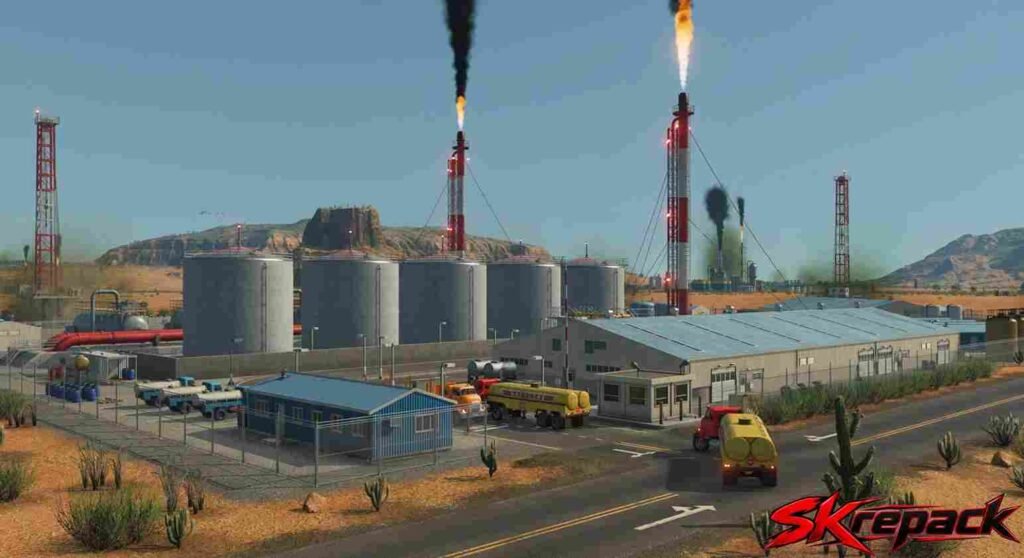
- Deep terrain and terraforming choices — you can either build routes around the natural landscape or reshape the terrain yourself, but heavy terraforming lowers local population satisfaction, so it’s a genuine cost-benefit decision rather than a free option.
- Rebuilt infrastructure tools — free-form road shaping, custom intersections, and lane-specific traffic control give you much finer control over how vehicles move through your network than earlier games in the series.
- Redesigned cargo and industry system — over 35 industries (including offshore ones like fishing and oil platforms) with warehouses and specialized terminals, meaning supply chains are something you actively manage rather than something that runs on autopilot.
- Dynamic vehicle maintenance — vehicles wear down over time, and ignoring upkeep has real gameplay consequences, adding a maintenance layer that wasn’t as central in previous entries.
- 125+ years of vehicle progression — more than 275 vehicles across trains, trucks, buses, trams, ships, aircraft, and helicopters, spanning the whole history the game covers.
- Three main play modes — Tycoon (economic challenge with adjustable difficulty), Sandbox (unrestricted building with strong mod support), and Campaign (missions based on real historical transport scenarios).
- In-game map editor and mod browser — you can build custom maps from heightmaps or from scratch, and share or download community content directly through the built-in browser.
- Living city simulation — individual residents have homes, jobs, and daily routines, which ties population growth and satisfaction directly to how well your network serves them.

Visit More Games:
Gameplay and Player Experience
The game is built around three ways to play. Tycoon mode is the traditional economic-pressure experience, with adjustable difficulty for how aggressively the game challenges your finances. Sandbox mode strips away (or lets you disable) the economic pressure entirely, so you can focus purely on building an aesthetically pleasing network, map, or city. Campaign mode gives you a structured set of missions built around real historical transport problems, which functions as both a tutorial path and a longer-form challenge mode.
Progression in the tycoon/campaign context is tied to how well you manage growth: as cities expand, their transport needs change, so a network design that worked for a small town may not scale to a major city without rework. Traffic simulation adds another layer — the game models lane behavior and overtaking, so congestion is something you actively design around rather than something abstracted away.
Modding is clearly a priority for this entry. Between the improved map editor and the in-game mod browser, players can bring in custom vehicles, buildings, and maps, which — based on the series’ history — usually extends how long a game like this stays active in a community long after release.
Platform and Availability
On PC, Transport Fever 3 is confirmed for Windows, macOS, and Linux, and it’s currently listed for pre-purchase on both Steam and GOG. The GOG version is DRM-free and doesn’t require GOG Galaxy to play, though Galaxy is used if you want cloud saves and achievement syncing. Steam’s minimum system requirements call for an Intel Core i5-8400 or AMD Ryzen 5 2600X, 8 GB RAM, a GTX 1060 or RX 480-class GPU with 4 GB VRAM, and 90 GB of storage on an SSD; the recommended spec steps up to a Core i7-13700K or Ryzen 7 7800X3D, 16 GB RAM, and an RTX 3070/RX 6800-class GPU.
A PlayStation 5 and Xbox Series X/S release is also planned, according to developer and press announcements, though neither console storefront listing was available to confirm pricing or console-specific requirements at the time of writing. If you’re planning to buy on console, checking the official PlayStation Store or Xbox listing closer to release is the safest way to confirm availability in your region.
For purchasing, Steam lists the base edition at $49.99 and a Deluxe Edition at $64.99 (which adds extra vehicles, landmarks, wildlife, and maps). Pricing on GOG matches the Steam base price. Always buy through Steam, GOG, or an official console storefront — Urban Games and Paradox Interactive are the only legitimate rights holders for this title.
Frequently Asked Questions
1. When does Transport Fever 3 release?
September 29, 2026, on PC (Windows, macOS, Linux) via Steam and GOG.
2. Will Transport Fever 3 come to PlayStation and Xbox?
Yes — a PS5 and Xbox Series X/S release is confirmed through developer and press announcements, though exact console pricing and requirements weren’t available on the storefronts checked for this article.
3. Is Transport Fever 3 a direct sequel to Transport Fever 2?
Yes, it’s the fourth game in the series overall and the direct successor to Transport Fever 2.
4. Does Transport Fever 3 support mods?
Yes. It includes an in-game map editor and a mod browser, and the GOG version is DRM-free, which typically makes modding more accessible.
5. What are the PC system requirements?
Minimum: Core i5-8400/Ryzen 5 2600X, 8 GB RAM, GTX 1060/RX 480 (4 GB VRAM), 90 GB SSD storage. Recommended: Core i7-13700K/Ryzen 7 7800X3D, 16 GB RAM, RTX 3070/RX 6800 (8 GB VRAM), same 90 GB SSD storage.

Final Overview
Transport Fever 3 is shaping up to be a substantial step forward for the series on paper — new terrain systems, a redesigned cargo economy, dynamic vehicle wear, and a day-night cycle are all confirmed additions rather than speculation. It’s built for players who already enjoy transport-tycoon or city-building games and want deeper systems to manage, rather than a simplified or casual take on the genre. Since the game hasn’t released yet, there’s no review data or player feedback to point to — what’s covered here reflects confirmed features and platform details only, not a judgment on how well those systems come together in practice.


1 Response
[…] Transport Fever 3 […]